
Dynamic Core Stability With Knees Stretches
When we practice on the Reformer here at the studio, the exercise called Knee Stretch appears near the end of the workout when we are nice and warm.
We start with Round Back (picture A), and then Arch Back (picture B) or Flat Back (picture C). We finish with the Round Back Knees Off version (not pictured). And sometimes we perform the hands/knees version with our hands on the wooden platform (picture D).
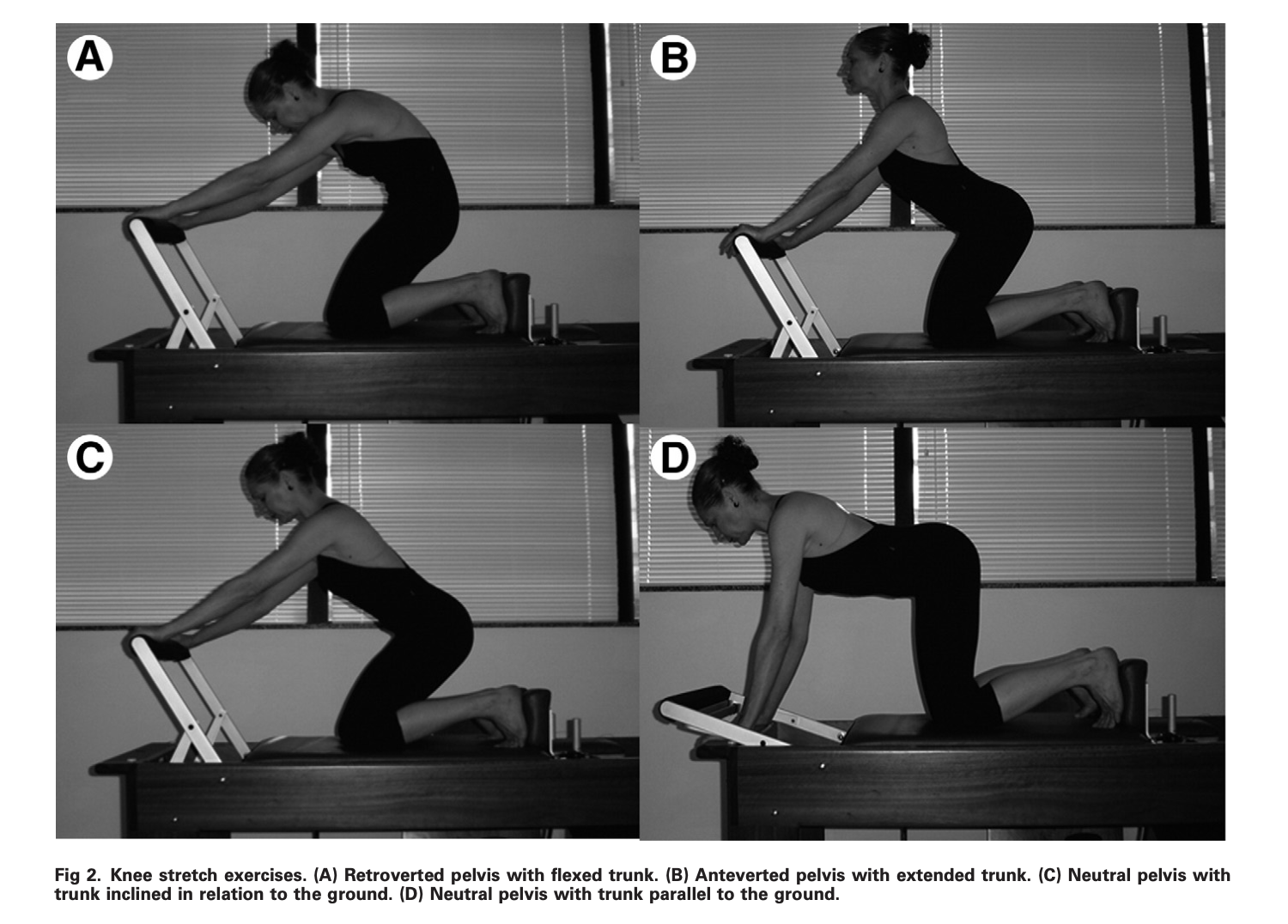
(Queiroz et al., 2010)
Knee Stretches are hip extension exercises as we push out the carriage with the load of two springs. Hip extension works glutes (butt muscles) and hamstrings (back of thighs). Knee Stretches are also a hip flexion exercise which works the quadriceps (front of thigh) when we resist the springs as the carriage moves forward to the stopper.
The hardest part of Knee Stretches is keeping the trunk still as the legs move forward and back, which is what creates dynamic core stability. Often, dynamic core stability exercises are clinically recommended as it plays an important role in preventing repetitive injury of intervertebral disks, facet joints, and related structures (Queiroz et al., 2010).
The purpose of the 2010 Knee Stretch study was to evaluate and compare the activation patterns of the trunk flexors and extensors (core), as well as, hip muscles in the four variations of Knee Stretches. They used electrodes on the right side of the torso and hips to record the data (Queiroz et al., 2010).
In this 2010 study the researchers discovered that Knee Stretch Round Back is highly effective in engaging the gluteus maximus (large butt muscle) and rectus abdominis (six pack ab muscles at front of torso) (Queiroz et al., 2010).
The Knee Stretch Arch Back and Flat Back are more effective in challenging the multifidus (lower back muscles) (Queiroz et al., 2010).
One cool discovery is that all four of the Knee Stretch versions engage the external and internal obliques equally effectively (Queiroz et al., 2010). Our obliques of our side core muscles of the trunk.
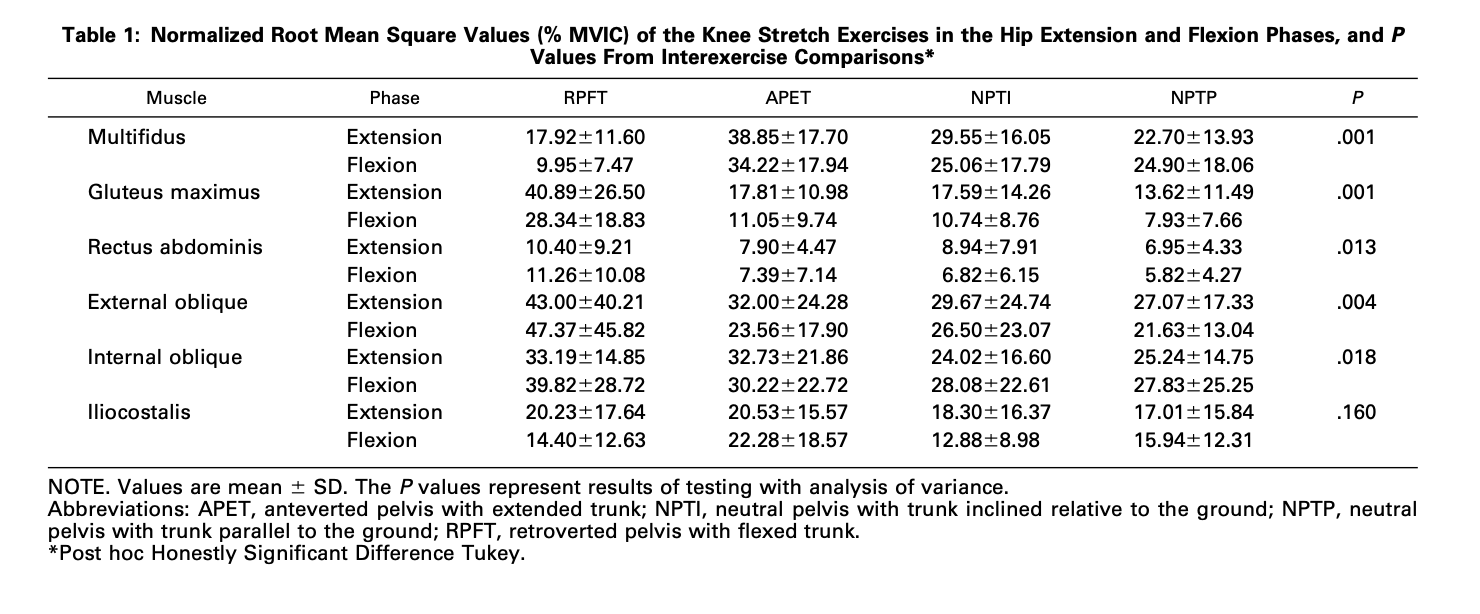
(Queiroz et al., 2010)
RPFT is Round Back, APET is Arch Back, NPTI is Flat Back, and NPTP is with hands on wooden platform.
Looking at table 1 numbers, notice how much the glutes are working in the Round Back position, up to 41%! If we untuck our pelvis, even just slightly, while performing the Round Back version, the exercise becomes less effective in the glutes. Similarly, with the Arch Back version, if we tucked under the pelvis when bringing the carriage in, even just slightly, the exercise wouldn’t work the back muscles to the same degree. Correct form really matters when performing Knee Stretches (but remember that Pilates a practice, not perfection!).
Another thing to note when reading the table 1 numbers is the large amount of external and internal oblique activation. The obliques help provide that important stability of the trunk, and is a key component to support the spine, rib cage, and pelvis, which is such a large focus of the Pilates Method.
This study demonstrates the effectiveness of Knee Stretches to build strength in our trunk to create much needed core stability, which is crucial for preventing injuries, developing muscular balance, and creating 360 degrees of support around the spine so we can move, run, jump, throw, lift, and transfer force throughout our body (Core Stability, n.d.).
I love reading and writing about these studies, really helps motivate me to do what we do. Hope you enjoy as well!
Resources
Core Stability. (n.d.). Physiopedia. Retrieved July 13, 2024, from https://www.physio-pedia.com/Core_Stability#:~:text=Having%20a%20strong%2C%20stable%20core,transfer%20force%20throughout%20our%20body.
Queiroz, B. C., Cagliari, M. F., Amorim, C. F., & Sacco, I. C. (2010). Muscle Activation During Four Pilates Core Stability Exercises in Quadruped Position. Archives of Physical Medicine and Rehabilitation, 91(1), 86–92. https://doi.org/10.1016/j.apmr.2009.09.016